
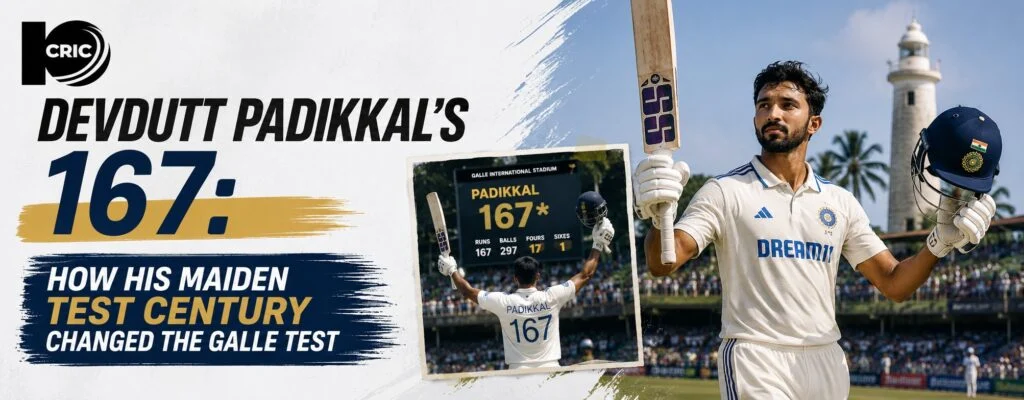
Devdutt Padikkal’s maiden Test century has become one of the biggest talking points from India’s first Test against Sri Lanka in Galle. His career-best 167 gave India the foundation for a huge first-innings total and showed the value of patience, technique and confidence in difficult conditions. For cricket followers tracking the match through platforms such as 10 Cric, Padikkal’s innings offered a perfect example of how one long batting performance can influence the direction of a Test. His contribution was not simply about reaching three figures. It changed the balance of the contest.
A Timely Opportunity for Padikkal
Padikkal entered the XI after Sai Sudharsan was ruled out through injury, giving him an important opportunity at No. 3. The timing could hardly have been more significant.
India needed someone capable of settling the innings after the early wickets, and Padikkal responded with composure. He had already produced strong performances for India A in Galle earlier in the summer, including a 94 in the second unofficial Test and a patient 67 in the first.
That previous experience mattered. Rather than treating the Galle surface as an unfamiliar challenge, Padikkal appeared comfortable with the conditions and understood the patience required.
How 167 Changed the Match
Padikkal’s innings was important because it gave India control for long periods of the first two days. He finished the first day unbeaten on 131 from 178 balls, with India at 288/2 after 73 overs.
The second day brought a different challenge. Rain delayed play considerably, and Sri Lanka’s spinners eventually found more assistance. India lost seven wickets for 172 runs after resuming from a strong position. Even then, Padikkal’s earlier work had already created a valuable platform.
He eventually made 167 from 230 balls, including 15 fours and a six. India finished their first innings on 462, later being bowled out for 462 on Day 3.
That total gave India’s bowlers something substantial to defend. By the end of Day 3, Sri Lanka were 271/7, still 191 runs behind.
Quality Over Risk
One of the most impressive aspects of Padikkal’s innings was its balance. He did not need to attack every ball to keep the scoreboard moving.
His 167 came from controlled stroke play, good shot selection and the ability to rotate the strike. That approach is particularly valuable in Test cricket, where a batter must manage different phases of an innings.
For viewers, this also improves the overall match experience. A high-quality Test innings gives fans more to analyse than a quick burst of boundaries. It highlights technique, concentration and tactical adjustments.
Comfort and Ease of Watching the Match
Modern cricket followers expect more than a final score. They want useful match information, player statistics, live developments and context that helps them understand why a game is changing.
Padikkal’s innings demonstrated this perfectly. His century was not an isolated statistic. It connected India’s early dominance, Sri Lanka’s spin response and the eventual first-innings advantage.
For platforms serving cricket audiences, presenting information clearly is therefore important. Whether someone is checking a score during work or following every session closely, easy access to relevant match information makes the experience more comfortable.
Why the Knock Shows Versatility
Padikkal has built his reputation across several formats, but a Test century in Galle adds another dimension to his profile.
His ability to adapt from limited-overs cricket to a long red-ball innings is significant. He had to manage a changing pitch, different bowling plans and long periods of concentration. His previous first-class record also showed that he possessed the foundation for this kind of performance. Before this Test, he had nine first-class centuries, including a career-best 232.
The 167 therefore looks less like a completely unexpected breakthrough and more like the result of skills developed over time.
What It Means for India’s No. 3 Position
India’s No. 3 position has attracted plenty of attention since the retirement of established middle-order figures. Padikkal’s performance gives the team management another strong option.
His century also carried historical weight. He became only the second Indian left-handed batter in the 21st century to score a Test century at No. 3, after Sourav Ganguly.
He also moved past Cheteshwar Pujara’s 153 for India’s highest score at No. 3 in a Test in Sri Lanka, with Rahul Dravid’s 177 still ahead of him.
One innings should not automatically guarantee a permanent place, but it certainly strengthens his case.
The Long-Term Value of the Performance
The greatest value of Padikkal’s 167 may become clear beyond this particular Test.
A young batter needs opportunities, but he also needs evidence that he can convert opportunities into substantial scores. Padikkal has now shown that he can bat deep into an innings at Test level, handle pressure and produce runs overseas.
For cricket fans, that creates a player worth watching over the longer term. For India, it provides another left-handed top-order option with experience in different formats.
Changing Expectations of Cricket Fans
Cricket audiences are increasingly interested in the story behind the numbers. A scorecard tells us that Padikkal made 167, but watching how he built the innings tells us why those runs mattered.
That is where thoughtful match coverage adds value. Fans want accurate statistics, clear explanations and context rather than simply a collection of headlines.
The Galle Test also showed why adaptability remains important. Rain interrupted play, Sri Lanka’s spinners fought back and India’s batting order had to adjust. Padikkal’s ability to stay focused through those changes was central to India’s strong position.
A Performance Built on Preparation
Padikkal later spoke about the consistent work that went into his breakthrough performance, while KL Rahul praised the batter’s quiet preparation and persistence.
That provides an important lesson for players and fans alike. Big performances often come from preparation that receives little attention. His earlier India A matches in Galle, domestic experience and continued red-ball work all contributed to making the opportunity count.
From a long-term perspective, this is also a reminder that thoughtful decision-making matters more than chasing immediate results. Building skills gradually can create stronger performances when the biggest opportunity arrives.
Conclusion
Devdutt Padikkal’s 167 was much more than his maiden Test century. It gave India a commanding first-innings platform, tested his ability to handle pressure and strengthened his case for a longer run in the Test side. India reached 462, and Sri Lanka ended Day 3 at 271/7, leaving the visitors with a significant advantage.
For fans following the Galle Test through 10Cric login, the innings will remain one of the defining moments of the match. More importantly, Padikkal has shown that he can combine patience, quality and versatility when India needs it most. As his Test journey develops, this 167 could prove to be the innings that changed the direction of his international career.
FAQs
1. How many runs did Devdutt Padikkal score in the Galle Test?
Devdutt Padikkal scored 167 runs, which is his maiden Test century and his career-best Test score.
2. How many balls did Padikkal face for his 167?
Padikkal faced 230 balls and struck 15 fours and one six during his innings.
3. Why was Padikkal playing at No. 3?
He came into India’s playing XI after Sai Sudharsan was unavailable due to injury and was selected to bat at No. 3.
4. What was India’s first-innings total in the Galle Test?
India were eventually bowled out for 462 in their first innings, with Padikkal’s 167 the highest individual score.
5. Did Padikkal’s century give India an advantage?
Yes. His long innings helped India build a substantial first-innings total, which left Sri Lanka under pressure. By the end of Day 3, Sri Lanka were 271/7 and still 191 runs behind India.


